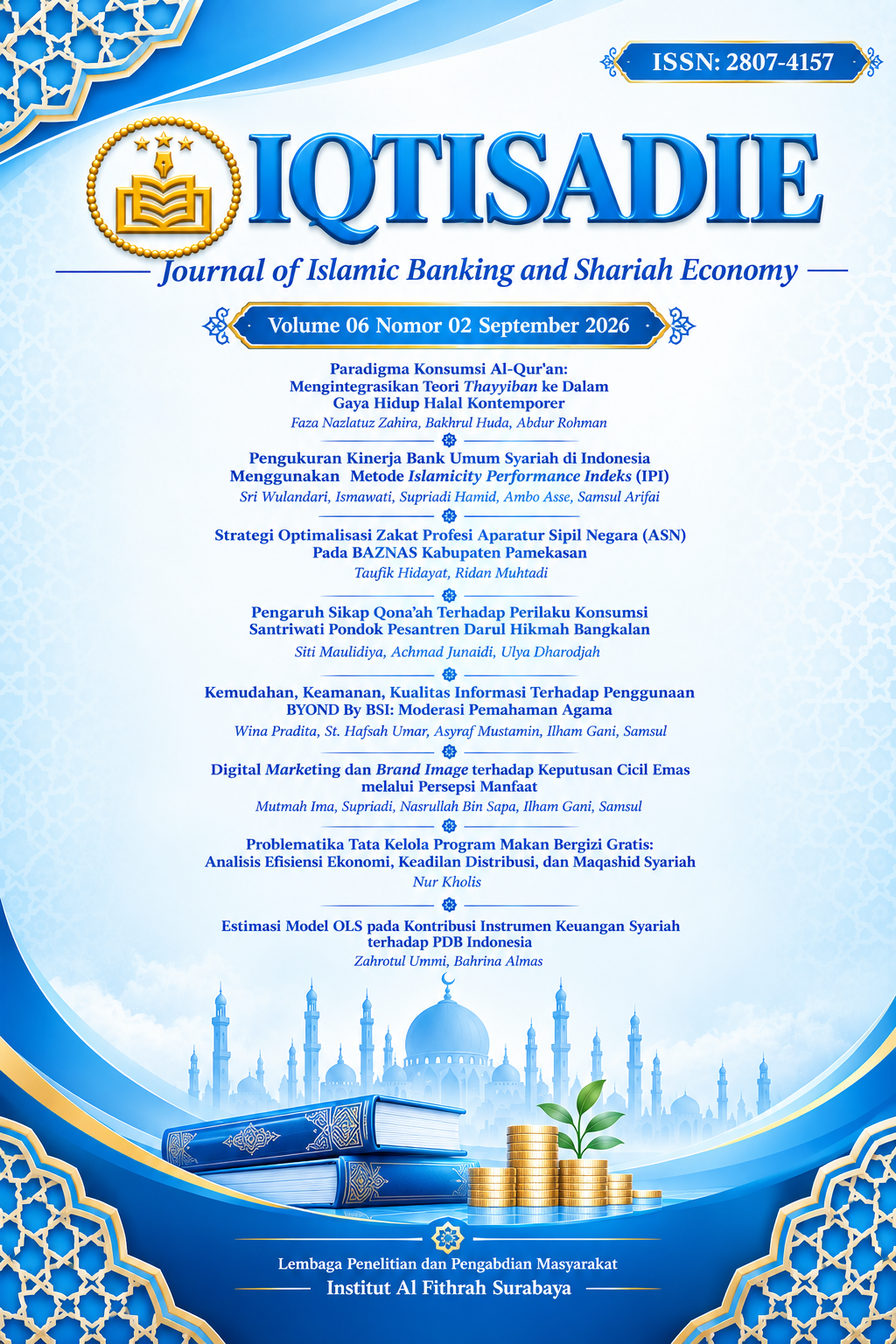
Pengaruh Sikap Qona’ah Terhadap Perilaku Konsumsi Santriwati Pondok Pesantren Darul Hikmah Bangkalan
DOI:
https://doi.org/10.36781/iqtisadie.v6i02.1458Keywords:
Qona’ah, Consumption Behavior, Female Students (Santriwati), Islamic Economics, Islamic Boarding School (Pesantren).Abstract
The rapid development of information technology, e-commerce, and social media has triggered a shift in the consumption patterns of the younger generation toward a consumptive lifestyle, and Islamic boarding schools (pesantren) are no exception. This study aims to empirically analyze the effect of the qona’ah attitude (contentment) on the consumption behavior of female students (santriwati) at the Darul Hikmah Langkap Burneh Islamic Boarding School in Bangkalan. This study employs a quantitative approach with a causal associative design. The population comprised 412 active female students, with a sample of 40 respondents selected through a purposive sampling technique based on criteria such as exposure to online shopping trends and monthly expenditure allocations. Data were collected using a structured Likert-scale questionnaire. The data were analyzed using validity tests, reliability tests, classic assumption tests (normality and linearity), and simple linear regression analysis via SPSS. The results of the hypothesis testing (t-test) showed a tstatistic value of 4,822 > ttable (1,68385) with a significance value of p < 0,001 (< 0,05). The regression coefficient was positive (b = 0,569), indicating a partial, positive, and significant effect of the qona’ah attitude on the female students' consumption behavior. These findings prove that the stronger the internalization of the qona’ah attitude, the more orderly, rational, and Islamic the consumption behavior of female students becomes in prioritizing primary needs (daruriyah) over secondary or tertiary desires
References
Augusna, W. L., & Rozalinda, R. (2023). Implementasi Pembiayaan Syariah Melalui Akad Musyarakah dan Mudharabah pada Financial Technology Syariah. Al-Masraf: Jurnal Lembaga …. https://pdfs.semanticscholar.org/848e/d0332247943f2683d921c0003ced5323ea07.pdf
Cholili, A. H., Putri, A. A., Azizah, M. N., Firdausi, F. S., & ... (2025). THE RELEVANCE OF QANA’AH ATTITUDE TO THE TENDENCY OF CONSUMER BEHAVIOR AMONG STUDENTS. RESILIENCE: JOURNAL OF ….
Dahjana, W. A. J., & Halimah, L. (2025). Pengaruh Sifat Qana’ah terhadap Perilaku Konsumtif pada Mahasiswa. Bandung Conference Series …. https://proceedings.unisba.ac.id/index.php/BCSPS/article/view/15908
DUHANI, M. (2022). HUBUNGAN QONA’AH DAN SYUKUR DENGAN PERILAKU KONSUMTIF PADA REMAJA. repository.uin-suska.ac.id. http://repository.uin-suska.ac.id/59134/
Fadhila, N. A. (2026). PENAFSIRAN AYAT-AYAT QONA’AH PADA PRINSIP FRUGAL LIVING PERSPEKTIF PARA MUFASSIR. repository.uinfasbengkulu.ac.id. http://repository.uinfasbengkulu.ac.id/6129/
Julitasari, R. (2017). Hubungan antara qana’ah dengan perilaku konsumtif pada siswa SMA Plus Negeri 2 Banyuasin III. UIN Raden Fatah. https://repository.radenfatah.ac.id/1488/1/Reiza Julitasari 12350149.pdf
Kurniawan, A. (2020). Pengaruh Antara Qana’ah Terhadap Perilaku Konsumtif Pada Mahasiswa Universitas Islam Riau. repository.uir.ac.id. https://repository.uir.ac.id/id/eprint/14322
Mahrusah, A. (2026). FLEXING DALAM AL-QUR’AN: ANALIS QS. AT-TAKATSUR PERSPEKTIF TAFSIR AL-JAILANI. Al-Furqan: Jurnal Agama, Sosial, Dan Budaya. https://publisherqu.com/index.php/Al-Furqan/article/view/4078
Mutiya, R. (2020). PENGARUH PEMAHAMAN MATERI TASAWUF AKHLAKI TERHADAP MENJAUHI SIKAP SHOPAHOLIC PADA MAHASISWI JURUSAN PENDIDIKAN AGAMA …. repository.uin-suska.ac.id. http://repository.uin-suska.ac.id/28486/2/GABUNGAN.pdf
Rahmadani, I., Rizki, R., & Restya, W. P. D. (2019). Pengaruh Sifat Qana’ah Terhadap Perilaku Konsumtif Pada Siswa/(I) Sma Negeri 3 Banda Aceh. Jurnal Bisnis Dan Kajian …. http://jurnal.utu.ac.id/jbkan/article/view/984
Rohmah, N. N. (2025). Pengaruh Fear of Missing Out (FOMO) dan Social Media Influencer terhadap Impulsive Buying Generasi Z dengan Qana’ah sebagai Variabel Moderating. repository.unissula.ac.id. https://repository.unissula.ac.id/39408/
SAFARI, S. (2025). PENGARUH E-COMMERCE, MEDIA SOSIAL DAN PERGAULAN TEMAN SEBAYA TERHADAP PERILAKU KONSUMTIF DALAM PERSPEKTIF ISLAM (Studi Pada …. eprints.untirta.ac.id. https://eprints.untirta.ac.id/id/eprint/49326
SRI, W. (2025). PENGARUH SHOPPING LIFESTYLE TERHADAP IMPULSE BUYING DENGAN FEAR OF MISSING OUT (FOMO) SEBAGAI VARIABEL MODERASI DALAM …. repository.radenintan.ac.id. https://repository.radenintan.ac.id/41764/
Wahidah, S. (2024). Perilaku Konsumsi Mahasantri Putri Ma’had Al-Jami’ah IAIN Ponorogo Perspektif Etika Konsumsi Islam. etheses.iainponorogo.ac.id. https://etheses.iainponorogo.ac.id/28406/2/SALMATUL WAHIDAH-102200050-HES.pdf
Downloads
Published
How to Cite
Issue
Section
License
Copyright (c) 2026 Siti Maulidiya, Achmad Junaidi, Ulya Dharodjah

This work is licensed under a Creative Commons Attribution 4.0 International License.