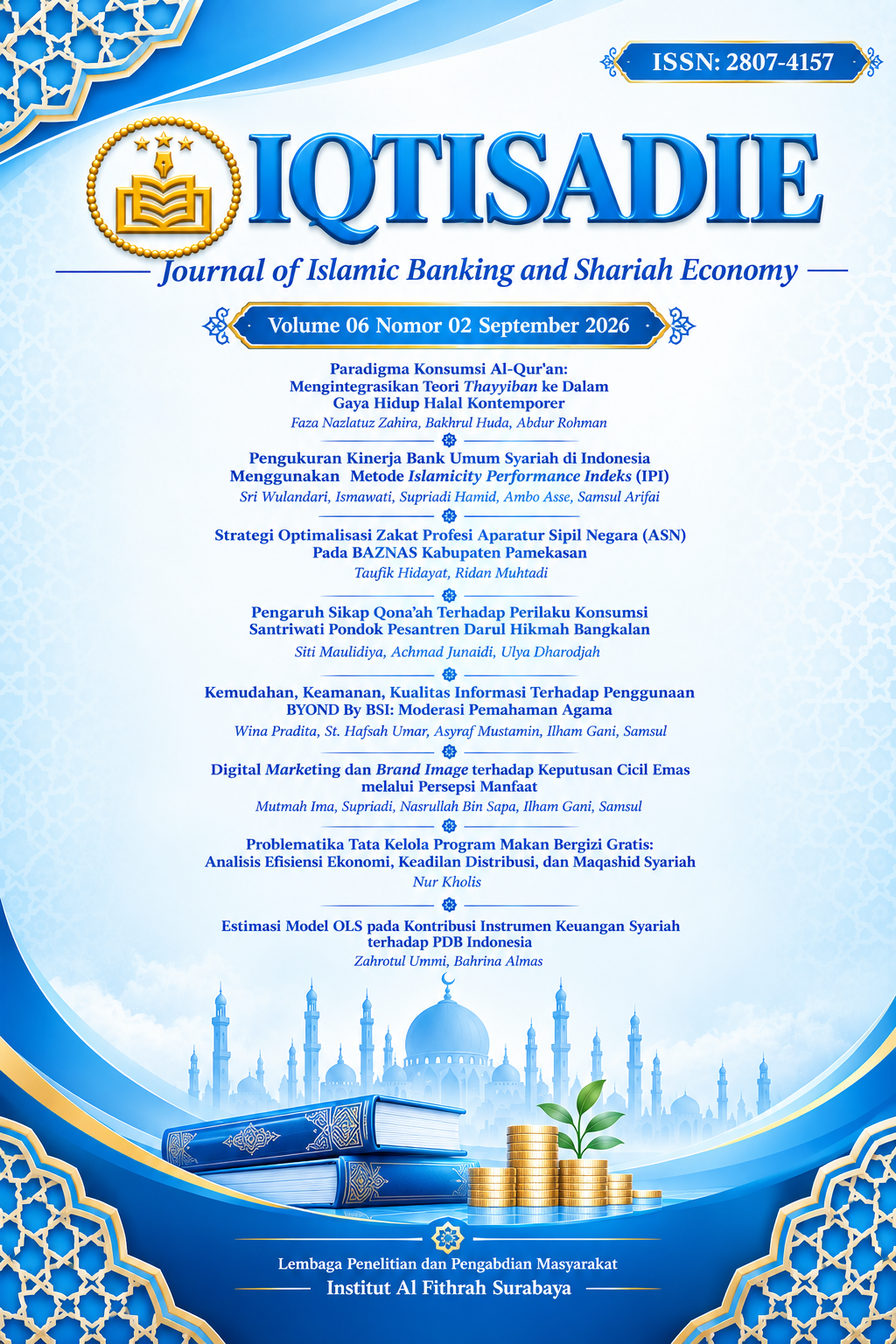
Problematika Tata Kelola Program Makan Bergizi Gratis: Analisis Efisiensi Ekonomi, Keadilan Distribusi, dan Maqashid Syariah
DOI:
https://doi.org/10.36781/iqtisadie.v6i02.1511Keywords:
Free Nutritious Meal Program; governance; economic efficiency; distributive justice; maqashid al-shariah; public policy.Abstract
The Free Nutritious Meal Program (MBG) is a public policy intervention that connects the agendas of nutritional improvement, human capital development, food security, and local economic empowerment. This study analyzes the governance challenges of MBG through three interconnected perspectives: economic efficiency, distributive justice, and maqashid al-shariah. The study employs a qualitative approach with a case study design, utilizing semi-structured interviews, observations, and document analysis as data sources. The data were analyzed using reflexive thematic analysis through deductive coding based on the three main perspectives and inductive coding of emerging operational issues. The analysis identifies six central issues: tensions between program expansion and local governance capacity; efficiency that cannot be equated with cost reduction; disparities in distribution quality; food safety as a governance issue; tensions between national standardization and local needs; and a shift in orientation from food distribution toward the achievement of public benefit. Recent literature indicates that school feeding programs can improve food consumption, food security, and several health outcomes, but their success is strongly influenced by policy design, implementation capacity, supply chains, food safety, and monitoring mechanisms. From the perspective of maqashid al-shariah, efficiency is positioned as an instrument for resource management, justice as a principle of distribution, while hifz al-nafs, hifz al-'aql, and hifz al-nasl serve as normative orientations. This study proposes an MBG governance model that integrates efficiency, justice, food safety, transparency, public participation, and public benefit as policy performance indicators.
References
Associated Press, “Nearly 2,000 Fall Ill in Suspected Food Poisoning Linked to Indonesia’s Free School Meals Program,” 5 September 2026. https://wtop.com/national/2026/09/nearly-2000-fall-ill-in-suspected-food-poisoning-linked-to-indonesias-free-school-meals-program/
Alami, Fathoni Nur, and Wily Mohammad. “Applying the Principles of Maqasid Al-Shariah to Address Poverty and Hunger in Indonesia.” Cognitionis Civitatis et Politicae 1, no. 2 (2024). https://doi.org/10.70177/politicae.v1i2.1115.
Andriani, Heni, et al. “A Multilevel Analysis of the Triple Burden of Malnutrition in Indonesia: Trends and Determinants from Repeated Cross-Sectional Surveys.” BMC Public Health 23 (2023): 1836. https://doi.org/10.1186/s12889-023-16728-y.
Berlianto, Jimmy Daniel, Rasya Athalla Aaron, and Sharfina Indrayadi. “Better Governance for Indonesia’s Free Nutritious Meal Program (MBG).” Center for Indonesian Policy Studies, 2026. https://doi.org/10.35497/690501.
Braun, Virginia, and Victoria Clarke. “Can I Use TA? Should I Use TA? Should I Not Use TA?” Counselling and Psychotherapy Research 21, no. 1 (2021): 37–47. https://doi.org/10.1002/capr.12360.
Galloway, Claire, Sue Devine, Julie Parison, and Holley-Anne Jones. “Procurement from Local Producers for Food Service in Primary and Secondary School Settings.” Health Promotion Journal of Australia 34, no. 2 (2023): 316–327. https://doi.org/10.1002/hpja.618.
Hamilton, Jill B. “Rigor in Qualitative Methods.” Qualitative Health Research 30, no. 2 (2020): 196–204. https://doi.org/10.1177/1049732319860267.
Jablonski, Becca B. R., Paul Milbourne, Siobhan Maderson, and Kevin Morgan. “Considering Tradeoffs in ‘Local’ Food Policies.” Frontiers in Nutrition 10 (2023): 1242493. https://doi.org/10.3389/fnut.2023.1242493.
Rose, Jeff, and Corey W. Johnson. “Contextualizing Reliability and Validity in Qualitative Research.” Journal of Leisure Research 51, no. 4 (2020): 432–451. https://doi.org/10.1080/00222216.2020.1722042.
Spill, Maureen K., et al. “Universal Free School Meals and School and Student Outcomes: A Systematic Review.” JAMA Network Open 7, no. 8 (2024): e2424082. https://doi.org/10.1001/jamanetworkopen.2024.24082.
Suprapto, Firre An, Editha Praditya, Reffi Marizka Dewi, and Wignyo Adiyoso. “A Policy Implementation Review of the Free Nutritious Meal (MBG) Program.” The Journal of Indonesia Sustainable Development Planning 6, no. 2 (2025): 297–312. https://doi.org/10.46456/jisdep.v6i2.798.
Downloads
Published
How to Cite
Issue
Section
License
Copyright (c) 2026 Nur Kholis

This work is licensed under a Creative Commons Attribution 4.0 International License.